AI research tools offer powerful ways to speed up information gathering, analyze complex data, and discover new connections. They can help with everything from literature reviews to summarizing findings, making your research process more efficient and insightful.
Understanding AI in Research
AI, or artificial intelligence, is about making computers think and learn. For research, this means tools can do things humans can’t do as fast. They can read tons of text quickly.
They can spot patterns in large data sets. This helps researchers find important information faster. It also helps them see things they might have missed.
Think about old research. You’d spend days in a library. Now, AI can scan millions of documents in minutes.
It’s like having a librarian with superhuman speed and memory. These tools aren’t here to replace human thought. They are here to boost it.
They handle the heavy lifting of data crunching. This frees you up for critical thinking.
There are many types of AI tools for research. Some help you find papers. Others help you understand them.
Some even help you write parts of your own work. Knowing what these tools can do is the first step. Then you can pick the ones that fit your research needs best.
My Own Research Journey with AI
I remember working on a big history project a few years back. It was about everyday life in the 1950s. I needed to find out what people ate for breakfast.
I spent hours looking through old magazines and books. I had stacks of notes. My desk was a mess.
I felt like I was drowning in paper. It was frustrating.
One evening, I stumbled upon an AI tool that promised to analyze text. I uploaded some digitized old newspapers. I asked it to find mentions of breakfast foods.
Within minutes, it spat out a list. It even told me how often certain foods appeared. It was a revelation.
I finished that part of my research in an hour. It would have taken me days before. That feeling of relief was huge.
It showed me the power of these tools.
Since then, I’ve tried many different AI research assistants. Some were amazing. Others were just okay.
But each one taught me something new. They showed me different ways AI could help. It’s a journey.
You learn as you go. You discover what works best for you.
AI Tool Spotlight: Literature Review Powerhouses
What they do: These tools scan vast databases of academic papers. They help you find relevant studies quickly. They can even group similar research together.
How they help: Saves hours of manual searching. Helps you see the big picture of existing research. Reduces the chance of missing key papers.
Top AI Tools for Finding Information
Finding the right information is key. AI tools can make this much easier. They go beyond simple keyword searches.
They understand the meaning of your query.
Semantic Search Tools
These tools don’t just match words. They understand the concepts you’re looking for. You can ask a question in plain English.
The AI figures out what you mean. It finds papers that discuss those ideas. This is great for complex topics.
Examples include tools that power many modern academic search engines. They use natural language processing (NLP). NLP helps computers understand human language.
This allows for more flexible and accurate searches. You can ask things like “What are the effects of climate change on small island nations?” instead of just typing “climate change island.”
Discovery Platforms
Some platforms are built around AI discovery. They suggest papers based on what you’re reading. They find related articles you might not have found otherwise.
They can also spot trending topics in your field.
These platforms often use machine learning. They learn your research interests. Over time, they get better at suggesting relevant content.
It feels like the tool is learning with you. This can open up new avenues for exploration.
Citation Chasers
Once you find a key paper, you need to see who cited it and what it cited. AI can automate this. It can build a map of research connections for you.
This helps you trace the evolution of ideas.
These tools are like building a family tree for research papers. They show you the ancestors (papers cited) and the descendants (papers that cite the current one). This is super important for understanding the context of a paper.
Quick Scan: AI Search Engine Types
- Concept-Based: Finds papers related to ideas, not just words.
- Recommendation Systems: Suggests new papers based on your reading.
- Network Analyzers: Maps how research papers connect to each other.
AI for Reading and Understanding Papers
Finding papers is one thing. Reading and understanding them is another. AI can help digest dense academic text.
Summarization Tools
Long papers can be overwhelming. AI summarizers read a document. They pull out the main points.
They create a shorter version for you. This helps you quickly decide if a paper is relevant.
These tools use different methods. Some pick out key sentences. Others generate new text that captures the essence.
You can often choose the length of the summary. This is a huge time-saver. It lets you skim more papers faster.
Key Concept Extraction
Beyond a simple summary, AI can pull out specific concepts. It can identify keywords, names, dates, and terms. This helps you grasp the core elements of a paper.
It’s like highlighting the most important parts for you.
This feature is great for comparing multiple papers. You can see what concepts are common. You can also spot unique ideas in each paper.
It aids in building your own understanding.
Question Answering
Some advanced AI tools can answer specific questions about a paper. You can ask, “What was the sample size?” or “What statistical test was used?” The AI will find the answer within the text.
This is incredibly useful for targeted information retrieval. You don’t have to reread sections hoping to find a detail. The AI goes straight to it.
It’s like having a research assistant who can instantly find facts in a book.
Contrast: AI Summaries vs. Human Summaries
| AI Summary | Human Summary |
|---|---|
| Fast, covers many papers. Can sometimes miss nuance. | Slow, deep understanding. Can be time-consuming for many papers. |
| Good for initial screening. Objective. | Better for in-depth analysis. Subjective interpretation. |
| Scalable for large literature reviews. | Best for understanding a few critical papers deeply. |
AI for Data Analysis and Insight Generation
Many research fields involve complex data. AI is transforming how we analyze it.
Pattern Recognition in Data
AI algorithms can find patterns in large data sets. This includes images, numbers, and text. They can spot trends that are invisible to the human eye.
This is crucial in fields like medicine or finance.
Machine learning models are trained on data. They learn to identify correlations. These correlations might be subtle.
They could be influenced by many factors. AI helps uncover these hidden relationships.
Predictive Modeling
Based on existing data, AI can build models to predict future outcomes. This is used in weather forecasting, stock market analysis, and even disease spread.
For researchers, this means they can test hypotheses about future events. They can see what might happen under different conditions. This adds a powerful layer to research planning and outcomes.
Sentiment Analysis
For research involving public opinion or social media, AI can analyze sentiment. It can tell if comments are positive, negative, or neutral. This is useful for understanding public reactions to events or products.
This tool is great for social sciences. It can analyze thousands of comments quickly. It gives a broad overview of feelings on a topic.
It’s much faster than reading each comment individually.
AI Data Analysis: Key Techniques
- Clustering: Grouping similar data points together.
- Classification: Assigning data points to categories.
- Regression: Predicting a continuous value.
- Anomaly Detection: Finding unusual data points.
AI for Writing and Organizing Research
Once you have your research, you need to present it. AI can help with this too.
Writing Assistants
Tools like Grammarly or Hemingway are becoming more AI-powered. They check grammar, spelling, and style. Some can suggest rephrasing for clarity.
They help make your writing polished.
More advanced AI writing tools can help brainstorm ideas. They can generate outlines. Some can even write first drafts of sections, like introductions or method descriptions.
You still need to edit and fact-check heavily.
Reference Management
Keeping track of sources is vital. While not purely AI, modern reference managers are integrating AI features. They can help auto-populate citation details.
They can also suggest related papers based on your library.
Tools like Zotero or Mendeley are essential. They organize your references. They help format bibliographies.
AI enhancements are making them even smarter. They ensure your citations are correct and consistent.
Plagiarism Checkers
Ensuring originality is critical. AI-powered plagiarism checkers compare your text against vast databases. They highlight any matching phrases.
This helps you avoid accidental plagiarism. It’s an important final check.
These tools are sophisticated. They can detect even subtle forms of text similarity. Using them is a good practice before submitting any work.
AI Writing Support: What to Watch For
Pros: Speed, grammar checks, style suggestions, idea generation.
Cons: Can create generic text, may make factual errors, lacks deep understanding. Always needs human review and editing.
Real-World Context: Where AI Shines
AI tools are not just for academic labs. They are used in many places.
Medical Research
Doctors and scientists use AI to analyze patient data. They look for disease patterns. They develop new treatments.
AI can predict drug interactions. It helps speed up drug discovery. The FDA is exploring AI in medical devices.
For example, AI can look at thousands of medical images. It can spot early signs of cancer. This is often faster and more accurate than a human alone.
This directly impacts patient care and outcomes.
Environmental Science
Researchers use AI to study climate change. They analyze satellite data. They model weather patterns.
AI helps track deforestation. It monitors pollution levels. This helps us understand our planet better.
The EPA uses data analysis tools to monitor environmental health.
AI can process vast amounts of sensor data. It can predict natural disasters. This gives communities more time to prepare.
It helps us react to environmental changes more effectively.
Social Sciences
Sociologists and psychologists use AI. They analyze large surveys. They study social media trends.
They look at public opinion. This helps them understand human behavior. Consumer Reports might use data analysis to understand product trends.
For instance, AI can analyze thousands of news articles. It can track how stories are reported. It can reveal biases.
This helps understand how information spreads. It shows how public perception is shaped.
AI in Action: A Quick Look
Healthcare: Diagnosing diseases, developing drugs.
Environment: Climate modeling, disaster prediction.
Business: Market analysis, customer behavior studies.
Education: Personalized learning paths, automated grading.
What This Means for You and Your Research
These AI tools are becoming more accessible. They can significantly improve your research process.
When It’s Normal to Use AI
It’s normal to use AI for any research task that involves large amounts of data. This includes literature reviews, data analysis, and even initial writing drafts. If you’re spending too much time on repetitive tasks, AI can help.
Think of AI as a smart assistant. It’s there to handle the time-consuming parts. This lets you focus on the creative and critical thinking.
It’s a tool to enhance your own skills, not replace them.
When to Be Cautious
AI is not perfect. It can make mistakes. It can misunderstand context.
Never rely solely on AI for factual information or critical analysis. Always verify AI-generated content. Be aware of the limitations of the specific tools you use.
AI models are trained on existing data. This data might contain biases. This means the AI’s output can also be biased.
It’s important to be aware of this. You should check for fairness and accuracy.
Simple Checks to Do
Always cross-reference information from AI tools with other sources. Read AI-generated text critically. Does it make sense?
Is it factually correct? Does it sound like human writing? If something feels off, it probably is.
For example, if an AI tool summarizes a paper, read the abstract or conclusion of the original paper too. This gives you a direct comparison. It helps confirm the AI’s understanding.
AI Usage: Normal vs. Concerning
Normal: Speeding up literature searches, summarizing articles, checking grammar, identifying data patterns.
Concerning: Using AI to write entire essays without input, accepting AI output as final fact, not checking for biases or errors.
Quick Tips for Using AI in Research
Here are some simple tips to get the most out of AI tools:
- Start Small: Don’t try to use every AI tool at once. Pick one or two that address your biggest research pain points.
- Learn the Tool: Most AI tools have tutorials or help sections. Take a few minutes to understand how they work.
- Be Specific with Prompts: When asking AI questions or giving commands, be as clear and detailed as possible.
- Iterate and Refine: If the first AI output isn’t what you need, try rephrasing your prompt. AI often gets better with feedback.
- Always Review: Treat AI output as a draft. Human judgment is still the most important part of research.
- Understand Limitations: Know that AI can hallucinate (make up facts) or be biased.
Frequently Asked Questions About AI Research Tools
What is the best AI tool for finding academic papers?
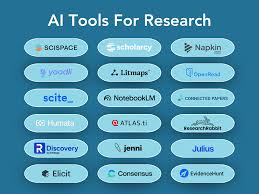
There isn’t one single “best” tool. Many academic search engines now use AI for semantic search. Platforms like Semantic Scholar, Scite.ai, and Elicit.org are highly regarded for finding and analyzing papers.
They use AI to understand your query better and suggest relevant research.
Can AI write my research paper for me?
AI tools can help you draft sections of a paper. They can suggest sentences or paragraphs. However, they cannot write a complete, original research paper on their own.
Human critical thinking, original analysis, and factual accuracy are essential. Relying entirely on AI can lead to errors and plagiarism issues.
How do I use AI to summarize research papers?
You typically copy and paste text into an AI summarization tool or upload a document. The tool then generates a shorter version of the content, highlighting the main points. You can often adjust the length of the summary.
Always read the summary and compare it to the original paper to ensure accuracy.
Are AI research tools biased?
Yes, AI tools can be biased. They are trained on data collected by humans, and that data may contain existing societal biases. It’s important to be aware of this potential bias.
Always critically evaluate the output of AI tools and cross-reference information with other sources.
What are the ethical concerns of using AI in research?
Ethical concerns include over-reliance on AI, potential for bias, data privacy issues, and academic integrity if AI is used to generate work without proper attribution. Transparency about AI usage is also important. Always check your institution’s guidelines on using AI.
How can AI help with data analysis in my research?
AI can help by identifying complex patterns in large datasets, performing predictive modeling, and conducting sentiment analysis. Tools can process numerical data, images, or text much faster than humans, uncovering insights that might otherwise be missed. This is especially useful in fields like science, medicine, and social sciences.
Conclusion
AI is a powerful ally for modern researchers. These tools can unlock new efficiencies. They can reveal hidden insights.
Embrace them wisely. Use them to boost your own intellect. Your research journey will become more productive and exciting.